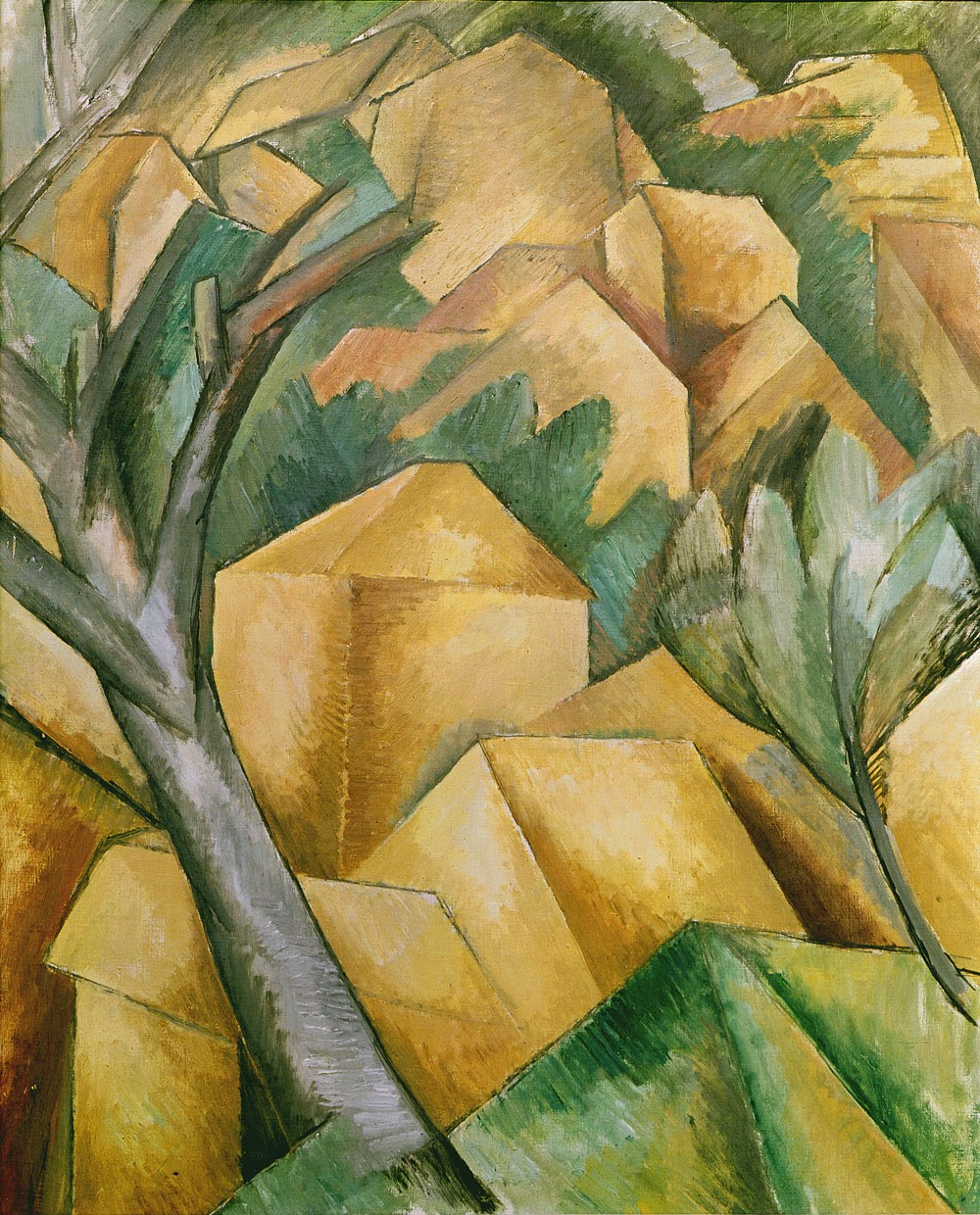
Artists broke from tradition to explore abstraction, emotion, and experimentation, responding to industrialization, revolution, and modern life.
c. 1907–1914
Cubism transformed how space and form were represented. Objects were broken into geometric shapes and shown from multiple viewpoints. Perspective was flattened and reassembled. This movement laid the foundation for abstract art.
Georges Braque
1914
Collage-like Cubist tabletop where labels and objects flatten into patterns and signs.
Fernand Leger
Mechanized figures and bold color blocks capture modern movement and theater energy.
Juan Gris
1912
A precise, crystalline Cubist portrait built from sharp planes and cool harmonies.
Marcel Duchamp
A figure cascades through space as repeated forms, merging Cubism with motion studies.
A musician dissolved into overlapping facets, reducing form to rhythm and tone.
Pablo Picasso
A Cubist portrait abstracted into interlocking planes and bits of text, challenging recognition.
1908
Faceted planes turn houses and trees into early Cubist geometry based on Cézanne’s structure.
1907
Five fractured nudes confront the viewer; a radical step toward Cubism and modern art.